
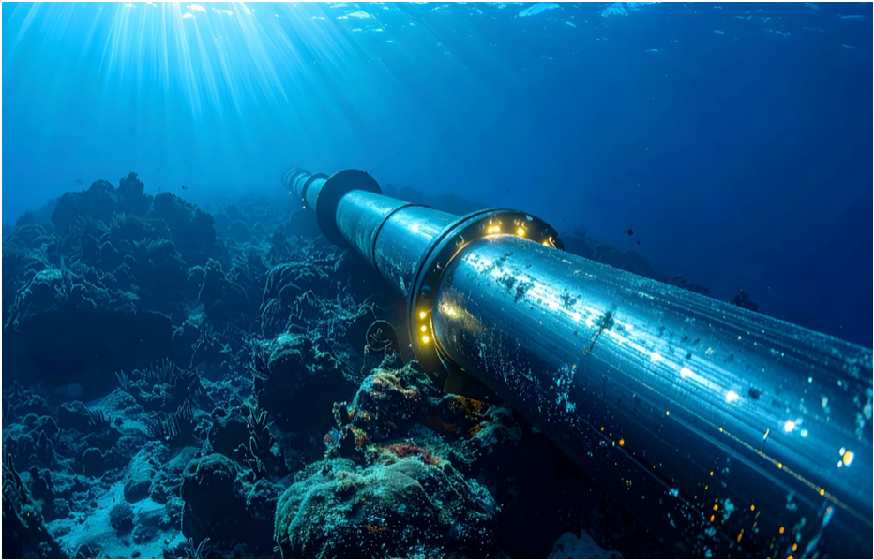
Quick question. When an analyst in New York opens a file stored on a server in Mumbai, how does the data get there? Most people guess satellites. It’s a fair guess, and it’s almost always wrong. Satellites, Starlink included, carry well under 1% of the traffic that moves between continents. The rest travels along the ocean floor.
Submarine cables are the least visible part of the modern enterprise, and probably the most important. Every cloud application, video meeting, and cross-border payment leans on them. This article explains what they are, how they support global enterprise connectivity, and what to look for in global enterprise solutions built on top of them.
What Are Submarine Cables, and Why Do Enterprises Depend on Them?
Submarine cables are fiber-optic lines laid across seabeds to carry data between countries and continents. They’ve been around for decades, and the scale is hard to picture. More than 99% of international data traffic runs on subsea cables, according to the ITU. If your business has offices, customers, or cloud regions in more than one country, your data is almost certainly riding one.
How Do Submarine Cables Support Global Enterprise Connectivity?
Cables don’t make headlines when they work. Here’s what they quietly do for a business every day.
- Fast, high-capacity links between regions
Fiber over a direct sea route keeps delay low and bandwidth high. That matters for voice, video, and anything interactive. Satellite links, especially from geostationary orbit, add noticeable lag, which is why cables remain the default for serious enterprise traffic.
- Reach into new markets
When a company opens an office in Lagos or Singapore, the first practical question is how it will connect to everything else. Landing stations around the world give carriers a way to extend your network to places you’d otherwise struggle to reach.
- Direct paths to cloud and data centers
Cloud regions and data centers sit at the ends of these routes. Strong subsea connectivity shortens the path between your offices and the platforms they use, so applications behave the same in Frankfurt as they do in Chicago.
- Resilience through route choice
No single cable is immune. Anchors, earthquakes, and conflict all cause faults. The value of a dense cable network is that traffic has somewhere else to go, provided your provider has planned for it.
- Room to scale
Newer systems are built with far more capacity than older ones, and they keep arriving. For a growing enterprise, that means bandwidth can usually be added without redesigning the network from scratch.
| Business need | What submarine cables provide | Typical use |
| Speed between regions | Low-delay, high-capacity fiber | Video, voice, trading |
| New market entry | Landing points in many countries | Branch and partner connectivity |
| Cloud access | Short paths to cloud regions | SaaS and data replication |
| Continuity | Alternate routes when a system fails | Disaster recovery |
| Growth | New, higher-capacity systems | Seasonal and project demand |
What Should You Look for in Global Enterprise Solutions?
Owning a cable isn’t realistic for most companies, so you’re really choosing a provider that knows how to use them well. A few questions help:
- Route transparency: Can the provider tell you which cable systems carry your traffic?
- Real diversity: Are your primary and backup paths physically separate, or do they share a system?
- Dedicated options: Is there a private, point-to-point option for critical applications?
- Coverage: Does the provider reach every market on your roadmap, including last-mile access?
- Support: Is there one team accountable across regions, around the clock?
Ask for answers in writing. Providers who’ve done this well tend to have them ready.
How Can Airtel Support Global Enterprise Connectivity?
Airtel Business connects multinational organizations across 50+ countries, with 75+ points of presence, 7 cable landing stations, and investments in 34+ submarine cables spanning 440,000+ route kilometers. Its global enterprise solutions bring together international connectivity, managed networking, and security under one partner.
For critical applications, Airtel’s international private line runs over a dedicated path with predictable latency, a 99.99% uptime commitment, and a minimum of three diverse paths on every route, so a single cable cut doesn’t take your sites offline. It suits financial systems, cloud gateways, and voice.
For US businesses with operations, suppliers, or customers in India, the Middle East, or Africa, one provider across those borders also means one team to call when a route degrades.
Conclusion
Submarine cables rarely get credit, but global business runs on them. Understanding how they work, and how your provider uses them, turns connectivity from a black box into something you can plan around.
If your company is expanding abroad, ask where your traffic actually travels. The answer says a lot about how resilient your network really is.